
Call us now :07971189145
 Send Inquiry
 Send Inquiry
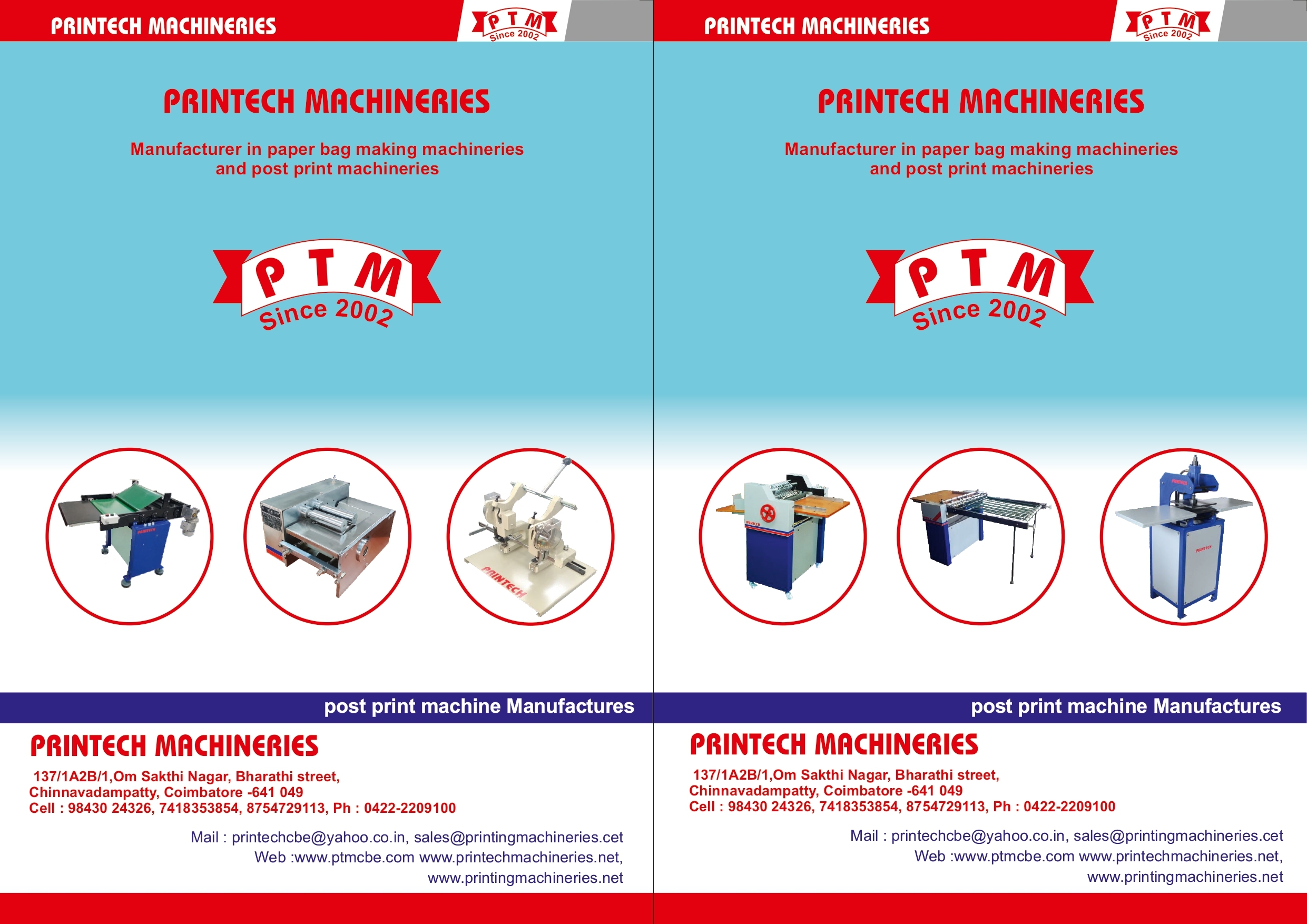
Roller Pressing Machine
MOQ : 1 Number
Roller Pressing Machine Specification
- Product Type
- Roller Pressing Machine
- General Use
- Laminating, pressing operations in packaging, plastics, textile and related industries
- Efficiency
- High efficiency with continuous processing capability
- Weight (kg)
- Approx. 300 kg
- Automatic Grade
- Automatic
- Drive Type
- Electric motor driven
- Bag Type
- Roll, Sheet and Flat Bags
- Computerized
- No
- Photoelectric Correction
- Yes
- Film Length Counter
- Yes
- Bag Length
- Adjustable, depends on application
- Power
- 2.2 kW
- Voltage
- 220V / 380V (customizable based on request)
- Material
- Mild Steel body, precision steel rollers
- Dimension (L*W*H)
- 1600 mm x 800 mm x 1200 mm
- Feature
- Smooth roller operation, precise pressing, robust construction, user-friendly interface
- Color
- Blue & Silver
- Safety Feature
- Overload protection, safety guards included
- Installation Requirement
- Level surface, standard power supply
- Roller Length
- 900 mm
- Operation Mode
- Continuous and manual options
- Maximum Working Width
- 850 mm
- Application
- Ideal for sealing, flattening, and compaction of sheet & flexible substrates
- Noise Level
- < 75 dB
- Control Panel
- Digital control panel with emergency stop
- Roller Diameter
- 120 mm
- Maximum Roller Pressure
- 5 Tons
- Operating Temperature Range
- 5°C - 45°C
- Roller Surface
- Chromium plated for corrosion resistance
About Roller Pressing Machine
- Simple to use, even for inexperienced operators
- Adjustable pressure and variable speed
- Minimal Power
|
Minimum Order Quantity |
1 Piece |
|
Max. Working Thickness Sheet |
Adjustable |
|
Motor Power |
0.5hp |
|
Automation Grade |
Semi-Automatic |
|
Customisation |
Customised |
|
Motor Type |
0.5hp |
|
I Deal In |
New Only |
|
Power |
0.5hp |
|
Speed |
variable |
|
Model Name/Number |
Roller Pressing |
|
Power Source |
Electric |
|
Usage/Application |
Industrial |
|
Load |
0-30 Ton |
Precision Pressing for Diverse Substrates
The machine's wide roller surface and adjustable pressure enable meticulous sealing, laminating, and flattening of various sheet and flexible materials. Its robust build and chrome plating add longevity and resist corrosion, making it reliable for industrial settings.
Advanced Control and Safety Features
Equipped with a digital control panel, emergency stop, overload protection, and safety guards, operators benefit from intuitive operation and risk mitigation. The machine ensures smooth, precise control and meets demanding safety standards required in modern manufacturing.
Efficiency Meets Versatility
Continuous and manual modes allow for flexible processing with high throughput. Photoelectric correction, film length counter, and bag length adjustments make it ideal for efficient production of roll, sheet, and flat bags.
FAQ's of Roller Pressing Machine:
Q: How does the roller pressing machine ensure consistent results during operation?
A: The machine uses precision steel rollers with a chromium-plated surface, alongside a digital control panel featuring photoelectric correction and adjustable roller pressure. These elements work together to maintain uniform pressing, sealing, and flattening over a maximum width of 850 mm.Q: What types of materials and applications can the roller pressing machine handle?
A: This machine is ideal for processing sheets and flexible substrates in packaging, plastic, textile, and related industries. It is specifically engineered for laminating, sealing, flattening, and compaction tasks involving roll, sheet, and flat bag forms.Q: When should I use the continuous mode compared to the manual mode?
A: Continuous mode is best suited for high-volume, uninterrupted production processes, maximizing throughput and efficiency. Manual mode is recommended for precise adjustments, small batch runs, or tasks that require close monitoring and fine-tuning.Q: Where should the roller pressing machine be installed to ensure optimal performance and safety?
A: Installation should be on a level surface with adequate space around the machine for safe operation and maintenance. Access to a standard power supply (customizable between 220V and 380V) and compliance with safety regulations are necessary for effective, safe usage.Q: What safety features are included in the roller pressing machine?
A: The machine is equipped with overload protection, safety guards, and an emergency stop button. These features are designed to protect operators and equipment from accidental overloads, mechanical hazards, and ensure rapid response in case of emergencies.Q: How is the noise level managed during machine operation?
A: The Roller Pressing Machine operates at a noise level below 75 dB, ensuring a quieter working environment. Its electric motor drive and precision components help maintain low sound emissions even during high-capacity processing.Q: What benefits does the chromium-plated roller surface provide?
A: Chromium plating enhances the rollers' resistance to corrosion and wear, ensuring long-term durability and consistent pressing quality. This surface treatment also reduces maintenance needs and optimizes the machine for intensive industrial use.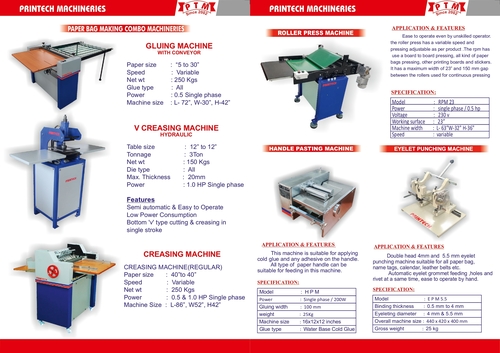
Tell us about your requirement

Price:
Quantity
Select Unit
- 50
- 100
- 200
- 250
- 500
- 1000+
Additional detail
Mobile number
Email

More Products in Paper Bag Combo Machineries Category
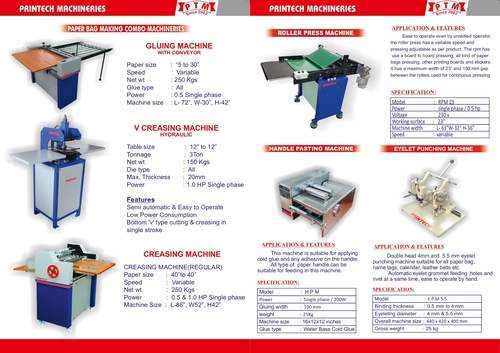
LOW BUDGET PAPER BAG MAKING MACHINE
Price Range 500000.00 - 700000.00 INR / Unit
Minimum Order Quantity : 1 Number
Automatic Grade : Other, Manual / Automatic
Product Type : Paper Bag Making Machine
Drive Type : Other, Mechanical
Color : Customizable
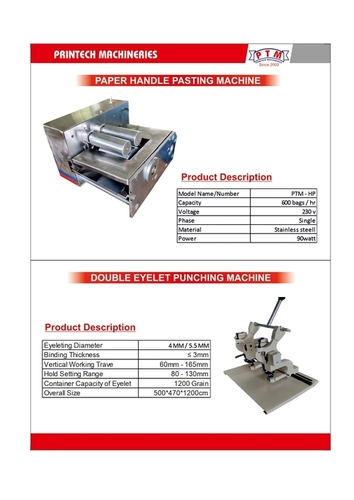
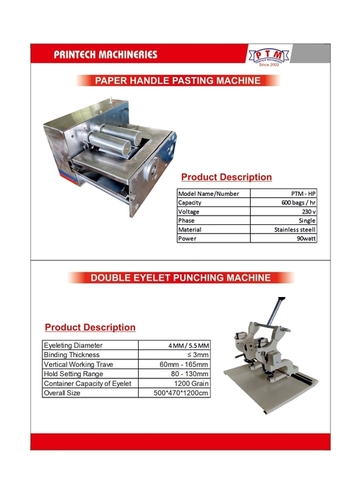
Paper Bag Handle Pasting machine
Price Range 48000.00 - 55000.00 INR / Unit
Minimum Order Quantity : 1 Number
Automatic Grade : Other, SemiAutomatic
Product Type : Paper Bag Handle Pasting Machine
Drive Type : Electric
Color : Silver
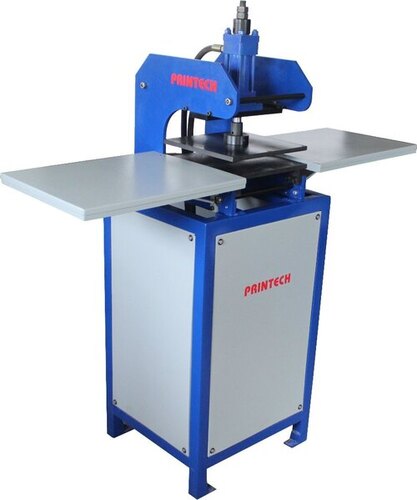
Handle Pasting machine
Price Range 48000.00 - 55000.00 INR / Unit
Minimum Order Quantity : 1 Number
Automatic Grade : Other, SemiAutomatic
Product Type : Handle Pasting Machine
Drive Type : Electric
Color : Silver
V Creasing And Cutting Machine
Price Range 120000.00 - 150000.00 INR / Unit
Minimum Order Quantity : 1 Number
Automatic Grade : Other, SemiAutomatic
Product Type : V Creasing And Cutting Machine
Drive Type : Electric
Color : Blue

 Send Inquiry
Our Products

SF.No 137/1A 2B Om Sakthi Nagar, Bharathy Street, Chinnavedampatti,Coimbatore - 641049, Tamil Nadu, India

Mr. Ananthan R.
(Proprietor)
Mobile :07971189145
 Send Inquiry
 Send SMS
Developed and Managed by Infocom Network Private Limited.
